
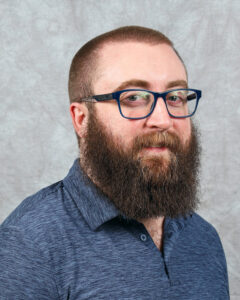
Dr. Joseph Ankrom, Culver-Stockton College
The Culver-Stockton College Genomics Research Institute, a yearlong course sequence that gives first-year students the hands-on research experience graduate programs look for, returns this fall under Dr. Joseph Ankrom.
CANTON, Mo. — This academic year, Culver-Stockton College (C-SC) is bringing back its Genomics Research Institute, a yearlong course sequence that puts first-year students on an original research project the same fall semester they arrive on campus.
The program is part of SEA-PHAGES, a national discovery-based research project aimed at undergraduate students new to college-level science and who have limited research experience. SEA-PHAGES — which stands for “Science Education Alliance – Phage Hunters Advancing Genomics and Evolutionary Science” — is supported by the Howard Hughes Medical Institute (HHMI).
To bring back the course sequence at C-SC, Dr. Joseph Ankrom, assistant professor of biology, prepared by participating in an intensive HHMI training institute, which included six and a half days of lectures and hands-on lab work running from 7 a.m. to 9 p.m. The training covered a semester’s worth of material and helped him to connect to faculty at partner institutions nationwide.
“One of the best things a college can do for its students is to put well-prepared faculty in front of them,” said Dr. Mike Seale, provost and vice president for academic affairs at Culver-Stockton. “Dr. Ankrom’s training with HHMI means first-year students will do research many undergraduates never get to experience, and graduate programs notice that.”
From Soil Sample to National Database
The word “phage” is short for “bacteriophage,” and Ankrom said phages are found in soil, water, and even the human body; however, phages only attack bacteria, not human or plant cells. Students who enroll in the course sequence find, isolate, and name new bacteriophages from environmental samples, then they sequence and analyze the phages’ genomes.
“As part of their projects, students collect their own soil samples, isolate a bacteriophage, and carry that single organism through the full arc of a scientific project: isolation, DNA extraction, sequencing, genome annotation, and submission to national databases. Students also get to name the phages they discover,” Ankrom explained. “Some schools pride themselves on giving authentic research experiences. We take a step further and do actual research with our students. They have the opportunity to run their experiments, write papers, and submit useful, relevant data to important databases by the end of their freshman year.”
Across the course sequence, students build the lab competencies that biology programs and employers expect, including micropipetting, gel electrophoresis, centrifuging, serial dilutions, and aseptic technique, plus DNA isolation, amplification, and extraction.
“If I were a professor looking for graduate students, I’d put anyone who did something like SEA-PHAGES at the top of my list regardless of other credentials,” Ankrom said.
The writing and submission work may matter as much as the lab work, he added. Learning to prepare a manuscript, submit data correctly, and present findings clearly are skills most students do not encounter until well into a master’s or doctoral program.
“If you have brilliant research but you can’t disseminate it in a useful way, its impact is negligible,” Ankrom noted. “Teaching students how to advocate for themselves and what they did is important in any field or profession.”
Ankrom said Culver-Stockton students who have completed the program have gone on to nursing, medical school, pharmacy, biotechnology, and veterinary medicine. Ankrom’s current senior teaching assistant, who took the course as a first-year student, is applying to veterinary school. The work also contributes to a problem with global stakes. As antibiotics lose effectiveness, the phage genomes catalogued by SEA-PHAGES students across the country build a library researchers hope will one day support targeted antibacterial treatments.
“This research is important. It isn’t solely to give students the best possible learning experience,” Ankrom said. “Many years down the road, the hope is that this leads to a build-a-bacteriophage targeted antibacterial treatment that could revolutionize our ability to treat bacterial infections.”
The sequence is offered at Culver-Stockton as BIO 250 (3 credits), BIO 251 (1 credit), and BIO 252 (3 credits), taken in order over a student’s first year. Enrollment is by invitation and currently limited to six to eight incoming students who commit to the full year. Prospective students may email Ankrom at jankrom@culver.edu to be considered.
Learn more about C-SC’s studies in genomics at culver.edu/academics/genomics.
Contact the Marketing & Public Relations Office, at pr@culver.edu or 573-288-6000 ext. 6728 for more information.
NOTE: A number that appears immediately after a person’s name (i.e. Jane Doe ’18) is a reference to the year that person earned their bachelor’s degree from Culver-Stockton.