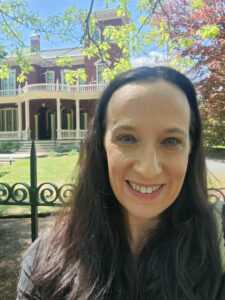
Dr. Alissa Burger at Stephen King’s former residence (now the home of King’s personal archive).
Dr. Alissa Burger’s research took her inside Stephen King’s personal papers in Bangor, Maine. She brought her Culver-Stockton College students’ work with her.
In the late 1990s, an undergraduate named Alissa Burger asked her professor if she could write an essay comparing Nathaniel Hawthorne’s “Young Goodman Brown” with Stephen King’s “One for the Road.” The answer was no. King, she was told, wasn’t literary. It couldn’t be done.
She wrote it anyway. She earned an A.
Nearly three decades later, Dr. Burger, associate professor of English at Culver-Stockton, is one of a small number of scholars granted access to Stephen King’s personal archive. Fewer still have left something of their own behind in it.
According to Burger, King’s papers were held for years at the University of Maine at Orono. The Stephen and Tabitha King Foundation has since moved them to the Kings’ former residence in Bangor, where they now sit in a standalone archive. Scholars who want to work there must apply, sharing information about what the project is, which documents they need, and what the research stands to gain. A board reviews every request.
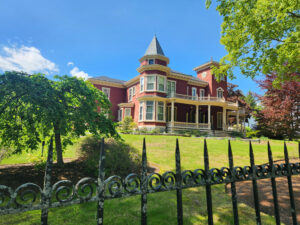
Stephen King’s former residence in Bangor Maine, now the home of his personal archive.
Burger’s request was approved, and she noted the rules inside are strict. Bags go in a locker, lunch goes in the fridge, and the only things allowed at the workstation are a laptop, a notebook and a pencil. No photographs. No photocopies. Every note is taken by hand.
Her days in the archive followed a rhythm set by Robin Furth, King’s longtime personal assistant and the archive’s curator. Folders were pulled and waiting each morning. Over coffee, Burger explained that she and Furth would go through a list of other materials worth seeing, so those could be retrieved while Burger worked. Lunch was spent talking with Furth and with Carrie, who keeps the foundation and archive in order. Afternoons meant more folders, more notes, and a final conversation about what to pull for the next day.
Among the most memorable items Burger came across was King’s handwritten responses to editor Chuck Verrill’s feedback on the collection “Nightmares & Dreamscapes.” King took some suggestions and rejected others, but what struck Burger was the tone: funny, needling, affectionate.
“This helped me see King not just as an author but as a person and as a friend to the guys he was corresponding and working with,” Burger said.
She also found the planning documents behind “The Talisman,” the novel King co-wrote with Peter Straub, including their outline and the notes they traded as the work got underway. That material is already reshaping a book chapter she’s writing on the King–Straub collaborations. Elsewhere in the files: letters from early readers of “IT,” many of whom raised the same objection to the novel’s ending. King kept his ending.
Burger says the archive corrected something she’d long suspected the public gets wrong about King, that the man matches the work.
“People equate King with the horror of his work, thinking he’s this really scary or spooky guy, when he is so warm and funny and caring,” she said. She also points to the philanthropic work King and his wife, Tabitha, have done across Maine, which she says gets far less attention than the novels.
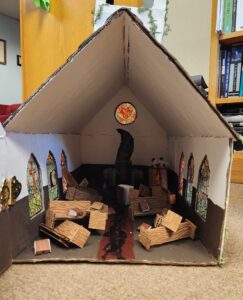
Student project from Dr. Burger’s ENG 130 course, a diorama (interior) of the church inspired by “Jerusalem’s Lot,” created by C-SC student Maddie Bradshaw in Spring 2025.
C-SC in the King Archive
Burger not only came away with abundant information about King and his work, but she also brought some creative work in. According to Burger, the program and photographs from C-SC’s Fall 2025 theatre production of “Carrie: The Musical,” along with creative student projects from her ENG (English) 130 course, are now part of the Stephen King archive.
That course, The Short Fiction of Stephen King, is offered during the College’s three-week term and ends with a creative interpretation assignment. Students have responded to King’s work with posters, dioramas, set and costume designs, model buildings, original music, and t-shirts. This fall, the class will read four King novellas, including “Rita Hayworth and the Shawshank Redemption,” “1408,” “Mr. Harrigan’s Phone,” and “The Life of Chuck,” each paired with its film adaptation.
King turns up in her other courses too, including ENG 205: Introduction to Literary Studies and ENG 425: Major Authors. Her work on teaching “Young Goodman Brown” alongside King’s “The Man in the Black Suit,” published last year in “The Nathaniel Hawthorne Review,” grew directly out of conversations with C-SC students.
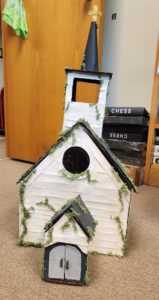
An exterior shot of C-SC student Maddie Bradshaw’s diorama representing the church in Stephen King’s “Jerusalem’s Lot.”
“I frequently tell my students that literature is part of an ongoing conversation,” Burger said. “I can share my perspective with them, which is often informed by my research, but my perspective is never the only perspective. By letting students see that process of research, engagement, and analysis, I work to create spaces within my classroom for them to do the same.”
What’s Next
Burger’s book manuscript on Stephen King’s Maine is currently in peer review, with feedback expected this fall. She is also at work on a chapter for a collection on Peter Straub and is coordinating remotely with the Peter Straub Papers at the New York University Library to obtain correspondence between the two authors.
The permission Burger had to argue for as an undergraduate is the one she hands her students on day one. While she had to fight to write about King, her students get to start there.
Learn more about Dr. Burger at https://culver.edu/directory/alissa-burger/ and C-SC’s English program at https://culver.edu/majors/english/.
Contact the Marketing & Public Relations Office, at pr@culver.edu or 573-288-6000 ext. 6728 for more information.
NOTE: A number that appears immediately after a person’s name (i.e. Jane Doe ’18) is a reference to the year that person earned their bachelor’s degree from Culver-Stockton.